Environmental footprints of high-pressure alkaline electrolysisWhat does the LCA tell us about the environmental performance of high-pressure hydrogen production?
Published: October 15, 2026
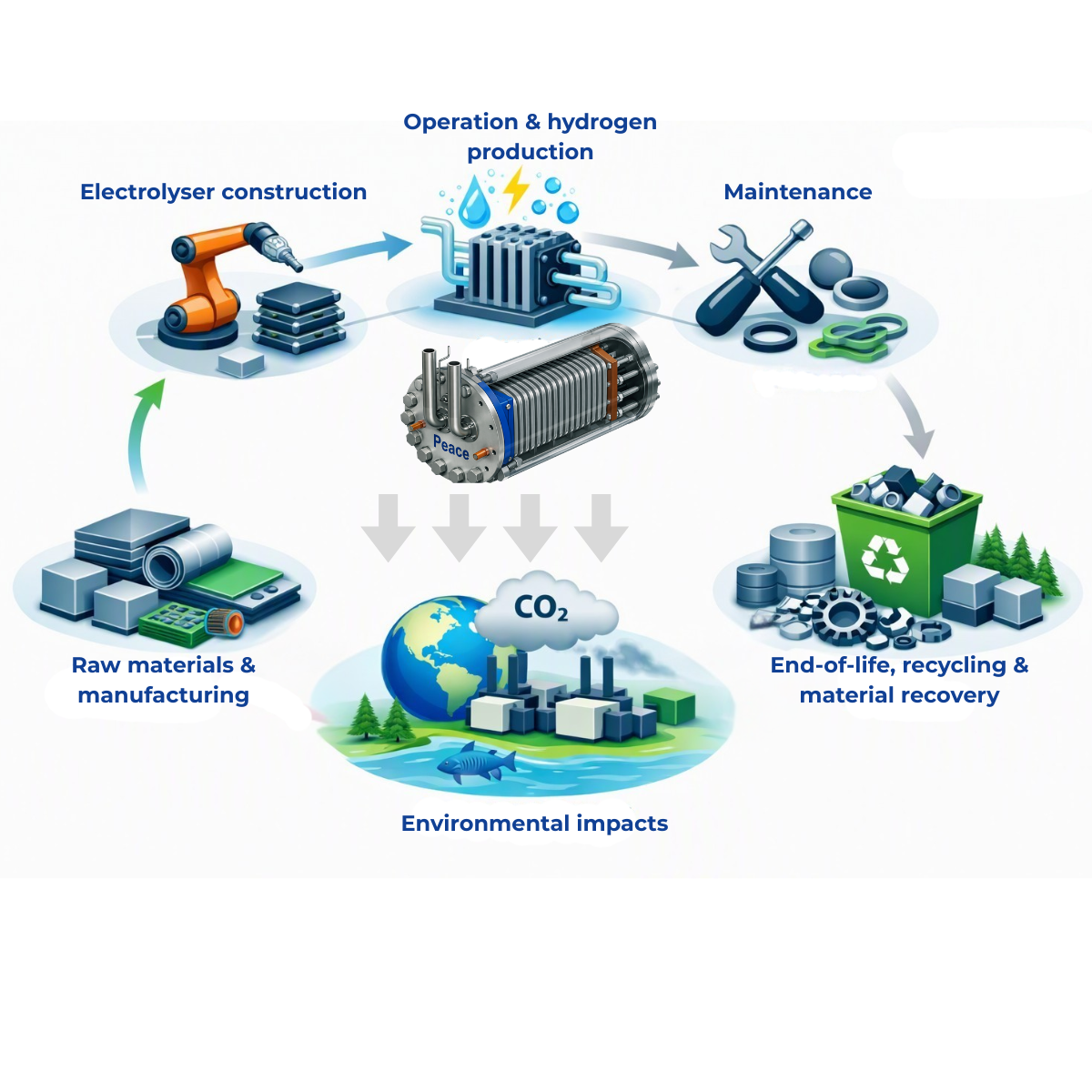
The PEACE project carried out the Life-Cycle Assessment (LCA) to evaluate the environmental performance of high-pressure alkaline electrolysis (see more on LCA HERE).
The work was led by Technical University of Denmark (DTU) in cooperation with the Hydrogen Chemistry Company (HyCC), German Aerospace Center (DLR) and Brandenburg University of Technology Cottbus - Senftenberg (BTU), bringing together expertise in environmental assessment, alkaline electrolysis and plant engineering.
The assessment is now complete, providing insights into the environmental factors that influence hydrogen production and the potential benefits of producing hydrogen directly at high pressure.
Electricity makes the biggest difference
One of the clearest findings is the importance of the electricity supply used to operate the electrolyser.
The LCA shows that electricity consumption is the dominant contributor to the climate change impact of hydrogen production. This means that the environmental performance of electrolysis is influenced not only by the technology itself, but also by the energy system supplying it.
The assessment therefore highlights the importance of combining efficient electrolysis technologies with low-carbon electricity sources to minimise the environmental footprint of hydrogen production.
The potential of direct high-pressure hydrogen production
The LCA also compared the PEACE concept, considering hydrogen production directly at 90 bar, with conventional alkaline electrolysis producing hydrogen at 1 and 30 bar, followed by hydrogen compression to 90 bar.
The results indicate an approximatively 9-10% lower climate change impact for the PEACE concept compared with the 1-bar production and subsequent compression reference. Compared with the 30-bar and subsequent compression reference showed a 3-4% lower climate change impact for PEACE. The main advantage comes from avoiding the additional compression step required to bring lower-pressure hydrogen to the required output pressure.
What does this mean for the PEACE technology?
The findings indicate that high-pressure electrolysis has the potential to reduce the environmental impacts associated with hydrogen production, while also highlighting the critical role of the electricity supply.
For PEACE, these insights provide an additional perspective on the technology's development. Alongside efficiency, cost and technical performance, understanding environmental hotspots can help identify opportunities for further optimisation and support the development of more sustainable and circular hydrogen production systems.
The detailed LCA results, including the full assessment across the different electricity scenarios and environmental impact categories, will be presented in the forthcoming peer-reviewed scientific paper - to be available HERE: https://www.h2peace.eu/public-media/results
The project is supported by
the Clean Hydrogen Partnership and its members.

Co-funded by the European Union. Views and opinions expressed are however those of the author(s) only and do not necessarily reflect those of the European Union or Clean Hydrogen Partnership. Neither the European Union nor the granting authority can be held responsible for them.