PEACE project sheds new light on bubble dynamics in alkaline water electrolysis
Published: September 1, 2026

A newly published peer-reviewed article from the PEACE project provides important insights into how hydrogen and oxygen bubbles behave inside alkaline water electrolysers and why understanding their dynamics is important for enabling more efficient, high-current-density operation.
PEACE project researchers Saksham Pandey and Matheus (Thijs) de Groot from the Department of Chemical Engineering and Chemistry at Eindhoven University of Technology (TU/e) have co-authored the article “Oxygen sticks, hydrogen glides — but current density decides!: Bubble dynamics in alkaline water electrolysers”, published in the Journal of Power Sources.
The study investigates bubble behaviour under conditions relevant to industrial alkaline electrolysers, using a transparent flow cell with 30 wt% KOH and high-resolution, high-speed imaging capable of visualising micron-sized bubbles near the electrode surface. The experiments were conducted at current densities up to 0.5 A/cm².
The publication highlights three key findings:
- Oxygen and hydrogen bubbles behave very differently
Oxygen bubbles exhibit a “sticky” behaviour, remaining attached to the electrode and growing significantly through coalescence. In contrast, hydrogen bubbles remain in a mist-like phase, with smaller bubbles that tend to glide along the electrode surface and show considerably less coalescence.
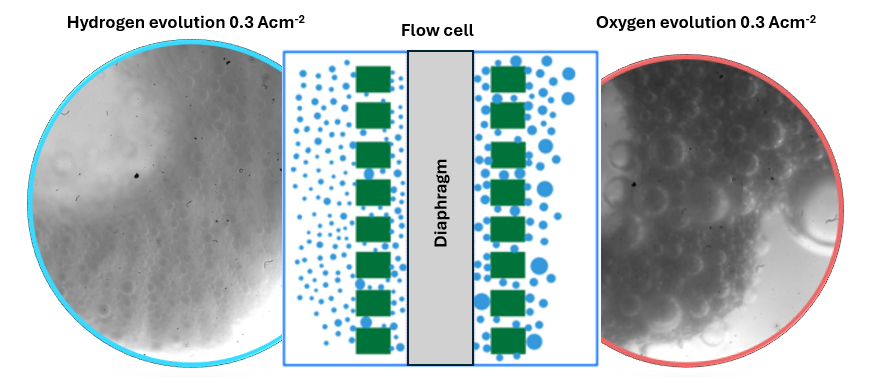
Visualisation of gas bubbles in an alkaline electrolyser cell
Source: Pandey et al. 2026 (CC BY 4.0)
- Current density – rather than electrode potential – governs bubble dynamics
Polarity-switch experiments showed that bubble adhesion and repulsion are not simply determined by whether hydrogen or oxygen is being produced. Bubble dynamics correlate strongly with current density rather than electrode potential.
The study's force analysis suggests that current-density-dependent solutal Marangoni forces play an important role in governing bubble behaviour, particularly at higher current densities.
- Understanding bubble behaviour is essential for high-current-density electrolysis
The study provides new experimental evidence under conditions directly relevant to industrial alkaline electrolysers. The distinct behaviour of hydrogen and oxygen bubbles provides important insights into how gas bubbles contribute to electrolyser losses and how their effects could be controlled.
These insights can support the design of electrodes and electrolyser systems that minimise bubble-induced ohmic resistance and enable operation at higher current densities, contributing to more efficient and cost-effective alkaline hydrogen production.
The findings complement the PEACE project research into the effects of pressure, gas holdup and cell design on alkaline electrolysis performance, contributing to the project's objective of advancing high-pressure alkaline electrolysis technology for large-scale hydrogen production.
Article details
Title: Oxygen sticks, hydrogen glides —
but current density decides!: Bubble dynamics in alkaline water electrolysers
Authors: Saksham Pandey, Arif Kubilay Ozdemir, Nadezhda Georgieva Sinapova,
Ataollah Niyati and Matheus T. de Groot
Journal: Journal of Power Sources, 2026, Volume 691, Article 240883
The article is available in open access in the PEACE ZENODO community
Discover more PEACE project publications and conference presentations on our Public & Media page.
The project is supported by
the Clean Hydrogen Partnership and its members.

Co-funded by the European Union. Views and opinions expressed are however those of the author(s) only and do not necessarily reflect those of the European Union or Clean Hydrogen Partnership. Neither the European Union nor the granting authority can be held responsible for them.