High-pressure Hydrogen Production: Integration into Downstream Processes
Published: June 26, 2026
The PEACE project has successfully concluded its investigation into efficiency of high-pressure alkaline electrolysis integration into industrial hydrogen value chains.
As Europe seeks to accelerate the deployment of renewable hydrogen and reduce dependence on fossil resources, the ability to connect hydrogen production with downstream industrial applications becomes increasingly important. The PEACE project is addressing this challenge through the development of an innovative high-pressure alkaline electrolyser (AEL) concept capable of producing hydrogen at pressures exceeding 50 bar.
PEACE Project partners The Hydrogen Chemistry Company (HyCC) and Deutsches Zentrum für Luft- und Raumfahrt (DLR)have immersed themselves into process modelling activities focused on the integration of the PEACE electrolyser technology into downstream chemical production processes. The aim was to assess how high-pressure hydrogen production can contribute to more efficient and economically attractive industrial systems.
Integration Pathways
To evaluate the benefits of the PEACE concept, project partners developed detailed process simulations using ASPEN Plus. The modelling activities included steady-state mass and energy balances, assessment of hydrogen compression requirements, and comparisons between the PEACE technology and benchmark electrolysis systems operating at atmospheric pressure and at 30 bar.
The study explored the integration of the PEACE high-pressure AEL concept into three key application areas:
- Methanol synthesis;
- Ammonia synthesis;
- Hydrogen refuelling stations.
These sectors represent important markets for renewable hydrogen and are expected to play a significant role in Europe's transition to a climate-neutral economy.
Reducing Compression Demand and Improving Efficiency
One of the key findings of the study is the significant reduction in downstream hydrogen compression requirements when hydrogen is produced at elevated pressures. Compression represents an important energy demand in many hydrogen-based industrial processes, and reducing this requirement can improve the overall efficiency of integrated systems.
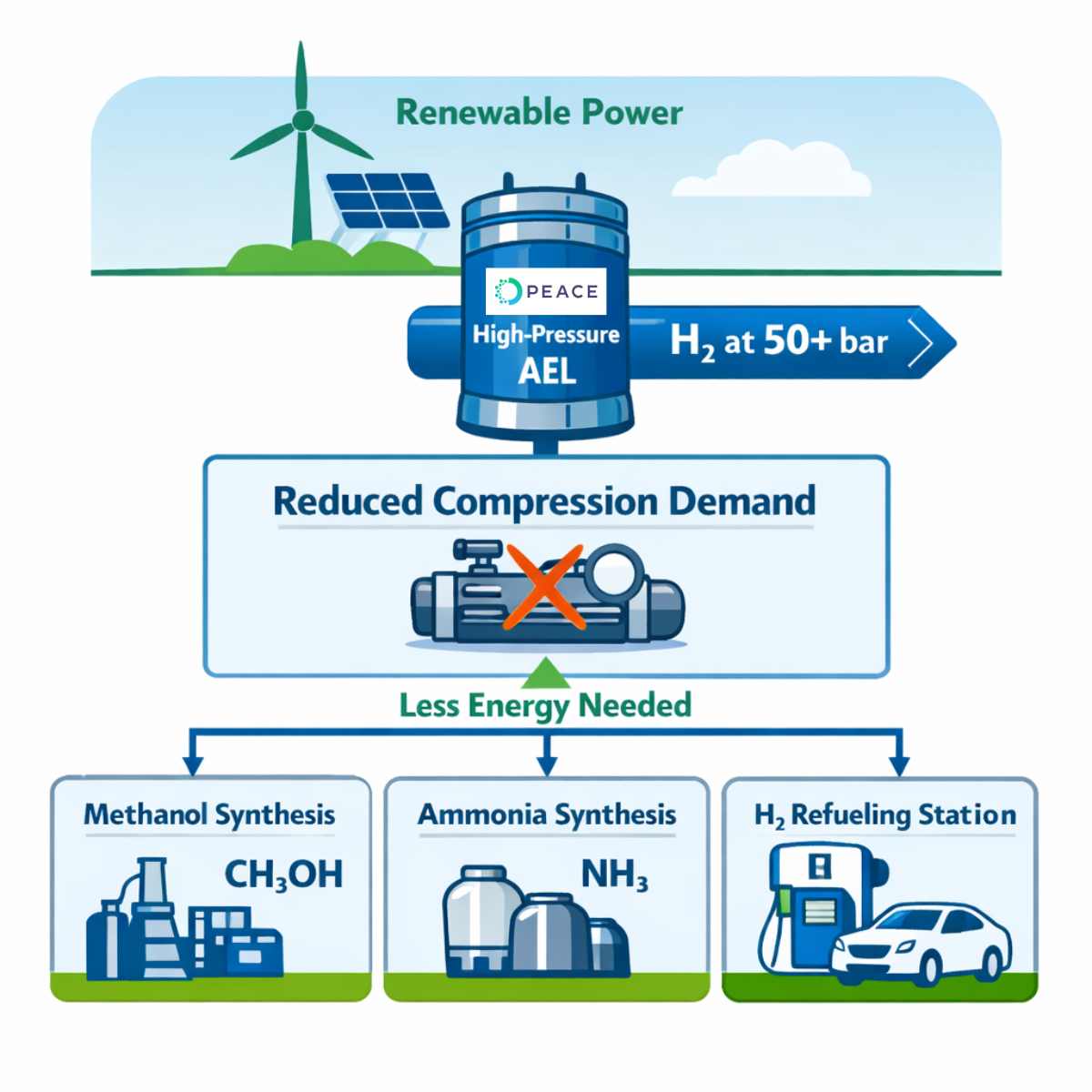
The simulations demonstrate that the PEACE high-pressure alkaline electrolysis technology can lower the energy needed for subsequent processing steps while maintaining compatibility with industrial applications that require pressurised hydrogen streams. As a result, the combination of high-pressure AEL with downstream conversion processes can deliver efficiency gains across the entire value chain.
The findings will support the continued development of the PEACE technology and contribute to the project's broader objective of advancing next-generation electrolysis solutions capable of accelerating Europe's clean energy transition.
The project is supported by
the Clean Hydrogen Partnership and its members.

Co-funded by the European Union. Views and opinions expressed are however those of the author(s) only and do not necessarily reflect those of the European Union or Clean Hydrogen Partnership. Neither the European Union nor the granting authority can be held responsible for them.